Speech Therapy for Lisps in Children: Signs, Causes & Treatment
Your child says “thun” instead of “sun,” or “yeth” instead of “yes.” At three, it barely registers. At six, you’re starting to wonder if it’s just a phase — or something a therapist should look at. That question has a clear answer, and it depends on which type of lisp your child actually has.
What Exactly Is a Lisp?
A lisp is a specific kind of articulation disorder. It affects how the tongue positions itself to produce the /s/ and /z/ sounds, so speech comes out distorted, muffled, or replaced with a “th” sound. It’s not a language delay — a child with a lisp usually understands everything said to them and can communicate their ideas just fine. Lisps are one of the most frequently treated speech sound disorders in clinical practice, and they respond well to structured therapy. The confusion for most parents isn’t whether their child has one — it’s whether it needs to be treated at all.
The 4 Types of Lisps (And Why the Difference Matters)
There are four recognized types of lisp, and each one involves a different tongue position — which means each one needs a different treatment plan. Get the type wrong, and therapy stalls.
- Interdental (frontal) lisp: The tongue pushes out between the front teeth, turning “sun” into “thun” and “sing” into “thing.” This is by far the most common type in young children.
- Dentalized lisp: The tongue presses against the front teeth instead of behind them, muffling the /s/ and /z/ sounds rather than replacing them entirely.
- Lateral lisp: Air escapes over the sides of the tongue instead of down the middle, giving speech a wet or slushy sound.
- Palatal lisp: The tongue makes contact with the soft palate, producing a sound further back in the mouth than /s/ or /z/ should ever be made.
Here’s the part parents often miss: not every lisp needs immediate correction. A mild interdental lisp in a child under five is considered a normal part of speech development, and it frequently resolves on its own without any intervention. Lateral and palatal lisps are a different story — they’re never considered a typical developmental stage, at any age, and should be evaluated by a speech-language pathologist as soon as they’re noticed.
| Lisp Type | What It Sounds Like | Resolves on Its Own? |
|---|---|---|
| Interdental (frontal) | “Sun” becomes “thun” | Often, if under age 5 |
| Dentalized | Muffled /s/ and /z/ | Sometimes, if under age 5 |
| Lateral | Wet, slushy /s/ | Rarely — needs therapy |
| Palatal | Sound made too far back | Rarely — needs therapy |
What Causes a Lisp in Children?
A lisp is classified as a functional speech disorder — meaning it develops without any underlying physical cause, and is more often tied to how a child learned to position their tongue during early speech development. A few common contributors:
- Prolonged thumb-sucking or pacifier use, which can push the tongue into an incorrect resting position over time
- Tongue-tie or restricted tongue mobility, which limits how precisely the tongue can move
- Dental or bite irregularities, such as an open bite, which changes where the tongue naturally sits
- Simply not having learned correct tongue placement during the window when /s/ and /z/ sounds typically develop
Braces are worth a specific mention here, since parents ask about them often. Orthodontic treatment can fix a bite issue that contributes to a lisp, but braces alone rarely eliminate the lisp itself — and in some cases, a child’s lisp temporarily gets worse as they adjust to new dental hardware. Speech therapy is still the piece that retrains the tongue.
Signs Your Child’s Lisp Needs Professional Attention
Watch for these rather than guessing:
- The lisp is lateral or palatal (wet, slushy, or “back of the mouth” sound) — this type doesn’t outgrow itself
- Your child is past age 5 and still substituting “th” for /s/ and /z/
- Your child avoids words with /s/ or /z/ sounds, or seems self-conscious about speaking
- Classmates or siblings have started commenting on how they talk
- The lisp coexists with a broader developmental profile — autism, ADHD, or global developmental delay (GDD) — where speech patterns often need a coordinated therapy plan rather than a wait-and-watch approach
That last point matters more than most parents realize. Left unaddressed, a lisp can start to affect a child’s confidence and social interactions, especially once classmates notice and comment on it. For a child already navigating autism, ADHD, or GDD, an unaddressed lisp adds one more barrier to communication and peer confidence — which is exactly why early, integrated support matters.
How Speech Therapy for Lisps Actually Works
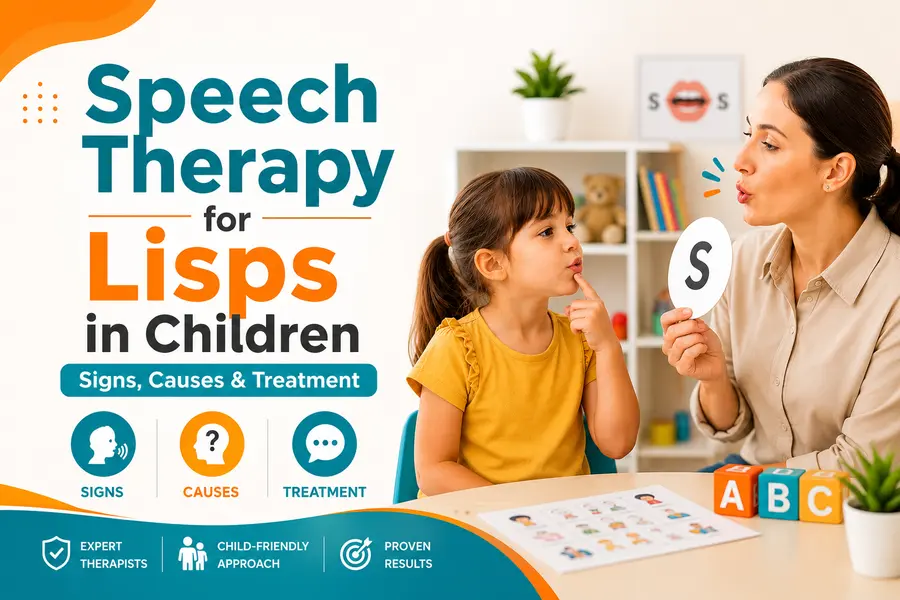
A qualified speech-language pathologist doesn’t start with exercises — they start with an evaluation. That means listening to your child produce target sounds in different word positions, checking oral-motor function, and in many cases reviewing developmental and medical history to understand the full picture. This evaluation identifies exactly which type of lisp is present, and that finding shapes the entire treatment plan.
From there, treatment typically progresses through stages:
- Sound isolation: Learning correct tongue placement for /s/ and /z/ on their own, often with visual and tactile cues
- Syllables and words: Practicing the new sound in simple, then increasingly complex, word combinations
- Sentences and conversation: Carrying the corrected sound into natural, spontaneous speech
- Generalization: Making sure the new sound holds up at school, at home, and with friends — not just in the therapy room
Most children complete treatment within three to six months of consistent weekly therapy, and home practice between sessions is one of the strongest predictors of how quickly progress happens. That second part is worth underlining — therapy that stays inside the clinic walls moves slower than therapy reinforced at home every day.
Is It Too Late If My Child Is Older?
No. Speech therapy remains the most effective treatment for a lisp at any age, and while earlier intervention tends to produce faster results, older children, teens, and even adults can achieve full correction with consistent practice and the right therapist. If your child is already 7, 9, or older and still lisping, the window hasn’t closed — it just means therapy is no longer optional in the way it might have been at age 4.
Why an Integrated Child Development Center Matters
For families managing a lisp alongside autism, ADHD, or global developmental delay, working with individual specialists in isolation often creates gaps — the speech therapist doesn’t know what the occupational therapist is working on, and neither is coordinating with what happens at home. A child development center approach puts speech-language pathology, behavioral support, and developmental therapy under one coordinated plan, so progress in one area reinforces progress in another. That’s the model TalkHear Speech & Hearing Clinic is built around.
Frequently Asked Questions
At what age should I worry about my child’s lisp?
A mild interdental lisp before age 5 is usually normal and often resolves on its own. If it persists past 5, or if it’s a lateral or palatal lisp at any age, it’s time for a professional evaluation.
Can a lisp go away without therapy?
Mild frontal and dentalized lisps sometimes resolve naturally in children under 5. Lateral and palatal lisps almost never resolve without structured speech therapy, regardless of age.
How long does speech therapy for a lisp usually take?
Most children complete treatment in three to six months with consistent weekly sessions, though timelines vary based on the type of lisp and how much practice happens at home.
Will braces fix my child’s lisp?
Braces can correct a dental issue contributing to the lisp, but they rarely eliminate the lisp on their own. Speech therapy is still needed to retrain tongue placement.
Is a lisp connected to autism, ADHD, or developmental delay?
A lisp itself is a speech sound disorder, not a sign of autism or ADHD. But children with these conditions often benefit from a coordinated therapy plan that addresses speech alongside their broader developmental needs, rather than treating the lisp in isolation.
What happens during a first speech therapy evaluation?
A speech-language pathologist will listen to your child produce sounds in different words, assess oral-motor function, and review developmental history to identify the exact type of lisp and build a targeted treatment plan.
Get a Speech Evaluation for Your Child
If your child’s lisp has lasted past age 5, sounds wet or slushy, or shows up alongside a broader developmental profile, waiting rarely makes it easier to fix. A proper evaluation tells you exactly what type of lisp you’re dealing with and how long correction is likely to take. Book an evaluation with TalkHear Speech & Hearing Clinic to get a clear answer instead of a guess.